That's right, $2,500 asking price and $25 shipping.
The Ebay text often says that the 5M is the "Holy Grail,"* so I guess somebody famous played that tip opening. I always thought that the 6M was the "Holy Grail," because that's what usually plays better for me. Here is a 6M that is $200 less, but I'm still not tempted.
Meyer Brothers Meyer Brothers Meyer Brothers
 Still over $2k for a little hunk of ebonite.
Meyer Brothers mouthpiece Meyer Brothers Meyer Brothers
Still over $2k for a little hunk of ebonite.
Meyer Brothers mouthpiece Meyer Brothers Meyer Brothers
Actually, many players find that a little larger tip plays even better than a 6M but, like the Otto Link Slant Signature, the vintage mouthpieces didn't come in modern tip openings. So we are going to make a larger tip opening, but label it a 6M.
Meyer Brothers Meyer Brothers Meyer Brothers
You should know that the $2,500 5M shown above has a gouge on the tip rail.
Meyer Brothers mouthpiece Meyer Brothers Meyer Brothers
Meyer Brothers Meyer Brothers Meyer Brothers
 Still over $2k for a little hunk of ebonite.
Actually, many players find that a little larger tip plays even better than a 6M but, like the Otto Link Slant Signature, the vintage mouthpieces didn't come in modern tip openings. So we are going to make a larger tip opening, but label it a 6M.
Meyer Brothers Meyer Brothers Meyer Brothers
You should know that the $2,500 5M shown above has a gouge on the tip rail.
Meyer Brothers mouthpiece Meyer Brothers Meyer Brothers
 You could pay somebody to fix this, although then you will no longer have an original 5M .
Meyer Brothers Meyer Brothers Meyer Brothers
Instead of altering the tip opening to get rid of the damage on a $2,500 carcass, lets just make ourselves a genuine new vintage Meyer Brothers alto 6M and save at least $2,000. We can use the money that we save to buy a nice vintage alto saxophone to put on the end of our new vintage mouthpiece.
Meyer Brothers Meyer Brothers Meyer Brothers
As with the tenor Link Slant Signature, we may need to find a vintage carcass. We don't want to make a later "Babbitt" Meyer alto mouthpiece because the earliest version of any mouthpiece is always the best (for some unknown reason). Fortunately, the later unworthy Meyer blanks are easy to recognize. On the later Meyer blanks, the two lines on the shank are very thin, as though they were cut in on a lathe rather than molded into the ebonite. Some of the no-name blanks don't have the lines at all, which makes me believe that they were cut in on later Meyer pieces (but not on other maker's use of the identical blank).
Meyer Brothers Meyer Brothers Meyer Brothers
Meyer Brothers Meyer Brothers Meyer Brothers
As with the tenor Link Slant Signature, we may need to find a vintage carcass. We don't want to make a later "Babbitt" Meyer alto mouthpiece because the earliest version of any mouthpiece is always the best (for some unknown reason). Fortunately, the later unworthy Meyer blanks are easy to recognize. On the later Meyer blanks, the two lines on the shank are very thin, as though they were cut in on a lathe rather than molded into the ebonite. Some of the no-name blanks don't have the lines at all, which makes me believe that they were cut in on later Meyer pieces (but not on other maker's use of the identical blank).
Meyer Brothers Meyer Brothers Meyer Brothers
Here an example of the thin lines.
 A later Meyer New York USA with the thin rings. BAD.
 Meyer Brothers New York with the wider molded rings. GOOD. Well worth the extra $2,000 if you are going to show it to other players.
 A later Meyer New York USA with the thin rings. BAD.
 Meyer Brothers New York with the wider molded rings. GOOD. Well worth the extra $2,000 if you are going to show it to other players.
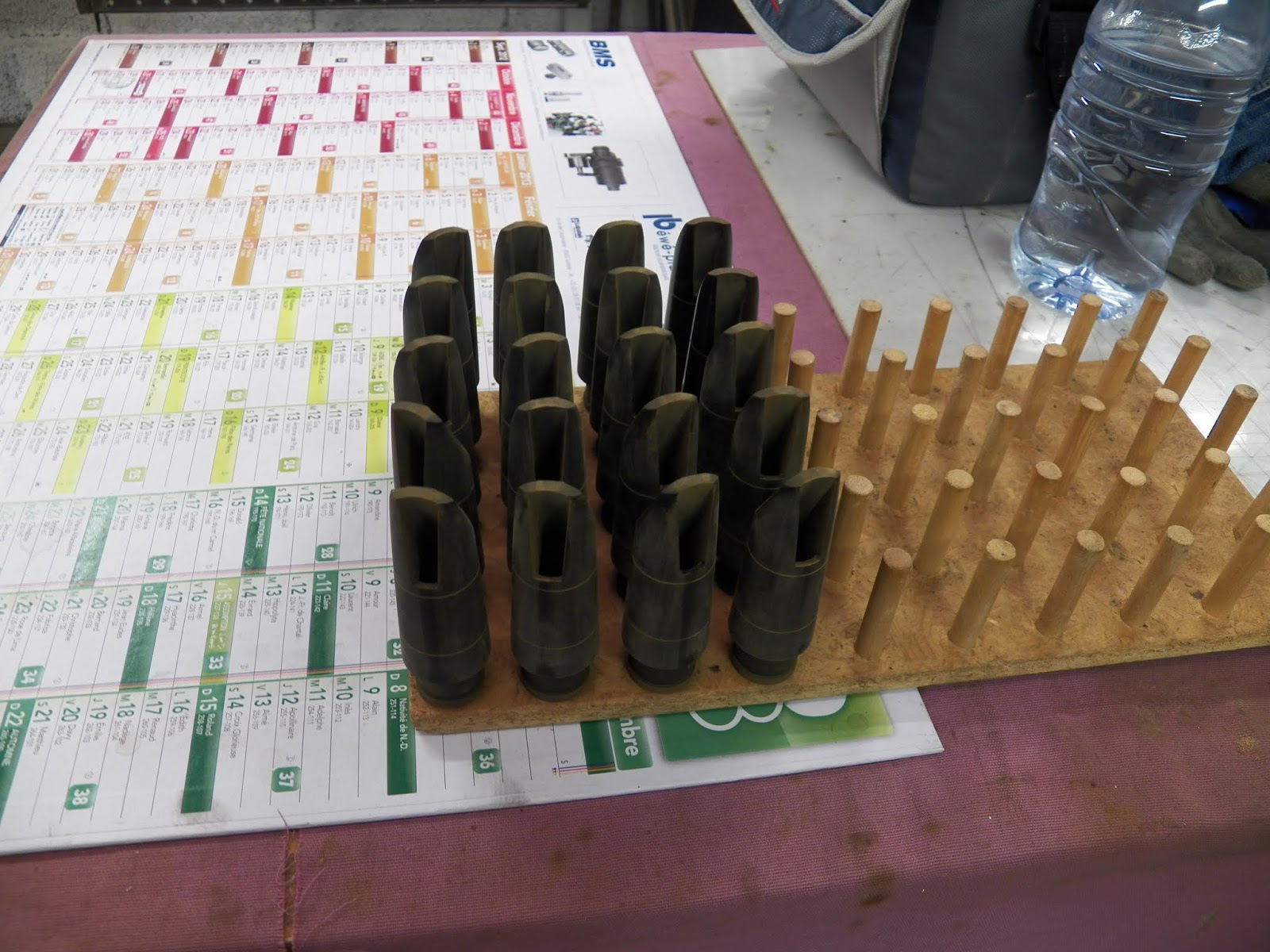
So, where are we going to find a blank carcass without the Meyer name on it to reface? Babbitt only sold these to a few other companies besides Meyer Brothers back in the day. Good thing that we now have a new source. An enterprising company has chosen to make these again. Out of ebonite. For a reasonable price ($39). And free shipping.
Here it is. It ships with an okay facing (no scratches, gouges, and discoloration like on an original), but it is a little smaller tip opening than a vintage 6M. And it only comes in a medium chamber, which is also okay because that seems to be the most popular vintage Meyer Brothers chamber.
 The wide cast-in rings that indicate a genuine vintage new Meyer Brothers piece.
 The official Meyer Brothers medium chamber made with secret recipe vintage ebonite.
 All it needs is an official vintage Meyer Brothers facing. Even better would be some Meyer Brothers embossing. The embossing is what players need to see to justify spending $2,500. These blanks are less than $40, including shipping.
 The wide cast-in rings that indicate a genuine vintage new Meyer Brothers piece.
 The official Meyer Brothers medium chamber made with secret recipe vintage ebonite.
 All it needs is an official vintage Meyer Brothers facing. Even better would be some Meyer Brothers embossing. The embossing is what players need to see to justify spending $2,500. These blanks are less than $40, including shipping.
Our blank does not come with anything embossed on it, and that will likely be one of the difficult aspects of creating a genuine vintage new Meyer Brothers alto 6M.
But first, the numbers. As with the prior blog on making a genuine vintage Link Slant Signature, we will rely on Keith Bradbury's website Mouthpiece Works for our alto 6M lay numbers:
But first, the numbers. As with the prior blog on making a genuine vintage Link Slant Signature, we will rely on Keith Bradbury's website Mouthpiece Works for our alto 6M lay numbers:
.0015" 41.2
.005 35.7
.010 30.7
.016 26.2
.024 21.3
.035 15.8
.050 9.6
.063 5.0
.078 .2
I should note that some of the tables for Meyer tip openings show that a #6 alto is .076," yet the lay shown above results in a .078 feeler gauge just barely slipping under the tip. A few things to remember. First, it is more important that the lay is smooth than the exact tip opening. Second, tables for Meyer tip openings varied over the years, so there is no agreed upon tip opening for a #6. Third, Meyer Brother mouthpieces were hand finished and varied from piece to piece. Fourth, if these unavoidable variations bothers you, you cannot be a mouthpiece finisher. You are what mouthpiece finishers call "customers" and you should not be reading this or measuring mouthpiece tip openings. If hand-finishing deviations bother you, just look at the number stamped on the side of a mouthpiece, tell everybody that number (even if they don't ask), and be happy.
I should also note that, according to one mouthpiece finisher, the standard tip openings of Meyer alto pieces actually changed over the years. Ralph Morgan provided numbers for 1939 Meyer alto pieces (Meyer Brother pieces) and 1970 Meyer alto pieces (then completely fabricated and finished by JJ Babbitt). According to Mr. Morgan, a 1939 6M had a tip opening of .085 inches and a lay of 20.6 mm (a Brand number of 41.2). A 1970 6M had a tip opening of .076 inches with the same lay of 20.6 mm. Obviously, the difference in tip opening would require different Brand numbers all the way down the curvature.
To further add to the confusion, as noted by Mr. Morgan, the designation "M" is generally related to the length of the lay, and not a "medium chamber." So the above "M" for medium lay at 20.6 mm might be correct despite the decreased tip opening over the years. The problem is that for the Meyer 6M tenor mouthpiece, unlike the alto, Mr. Morgan shows that the "M" medium lay went down from 24.8 mm to 20.6 mm over the years. So, like the Otto Link Tone Edge numbers shown in a prior blog, we basically don't have any idea what the lay on a vintage Meyer 6M alto piece should be.
And again, that can work to our advantage. We are not forced to adhere to some musty old numbers that somebody may have measured incorrectly or copied down wrong from a mouthpiece that might have been altered prior to the measuring. We could, if we want, use some old "official vintage Meyer Brothers #6 tip opening" of .085 inches and a lay of our own choosing. For instance, the chart given on Mouthpiece Works shows that a .085 tip opening should have a lay of 22.2 mm. And we can, if we choose, use Excel to alter and smooth the curve between any numbers that we choose. What is important is that, when finished, we stamp our new vintage Meyer Brothers alto with "6M" because that is what our favorite player used.
To save time, here are "new" computer-generated Brand numbers for an "old" Meyer Brothers #6 alto with a .086 tip opening.
I should also note that, according to one mouthpiece finisher, the standard tip openings of Meyer alto pieces actually changed over the years. Ralph Morgan provided numbers for 1939 Meyer alto pieces (Meyer Brother pieces) and 1970 Meyer alto pieces (then completely fabricated and finished by JJ Babbitt). According to Mr. Morgan, a 1939 6M had a tip opening of .085 inches and a lay of 20.6 mm (a Brand number of 41.2). A 1970 6M had a tip opening of .076 inches with the same lay of 20.6 mm. Obviously, the difference in tip opening would require different Brand numbers all the way down the curvature.
To further add to the confusion, as noted by Mr. Morgan, the designation "M" is generally related to the length of the lay, and not a "medium chamber." So the above "M" for medium lay at 20.6 mm might be correct despite the decreased tip opening over the years. The problem is that for the Meyer 6M tenor mouthpiece, unlike the alto, Mr. Morgan shows that the "M" medium lay went down from 24.8 mm to 20.6 mm over the years. So, like the Otto Link Tone Edge numbers shown in a prior blog, we basically don't have any idea what the lay on a vintage Meyer 6M alto piece should be.
And again, that can work to our advantage. We are not forced to adhere to some musty old numbers that somebody may have measured incorrectly or copied down wrong from a mouthpiece that might have been altered prior to the measuring. We could, if we want, use some old "official vintage Meyer Brothers #6 tip opening" of .085 inches and a lay of our own choosing. For instance, the chart given on Mouthpiece Works shows that a .085 tip opening should have a lay of 22.2 mm. And we can, if we choose, use Excel to alter and smooth the curve between any numbers that we choose. What is important is that, when finished, we stamp our new vintage Meyer Brothers alto with "6M" because that is what our favorite player used.
To save time, here are "new" computer-generated Brand numbers for an "old" Meyer Brothers #6 alto with a .086 tip opening.
.0015" 44.4
.005 38.9
.010 33.9
.016 29.3
.024 24.4
.035 18.9
.050 12.6
.063 8.0
.078 3.1These are closer to the numbers that I prefer and will be using on making my personal vintage Meyer Brothers 6M alto. My tip opening will actually be about .095 and I don't care if Meyer Brothers never made a tip opening that size. It just doesn't matter. (Open the link in a separate window so you can continue reading while listening to the motivational speech.) Below are the numbers that I ended up using. This would be a long facing in a tip size never offered by Ed and Frank Meyer.
| 48.2 |
| 42.5 |
| 37.5 |
| 32.5 |
| 27.5 |
| 21.7 |
| 15.1 |
| 10.4 |
| 5.6 |
I spent $39 for the blank and I already had the other required tools and materials on the workbench. If you have read some of the other Stuff Sax blogs, you know what to do to put on a facing curve. Getting it to play like a vintage Meyer 6M is the easy part, so I'll just skip to the difficult part of making an official vintage $2,500 Meyer Brothers 6M alto mouthpiece.
There will be another required expenditure beyond the normal tools. I bought this a while back when making the world's only known official vintage Rico M.C. Gregory C-Melody mouthpiece.

I don't remember exactly what I paid for the little laser (probably about $50). Maybe prices have come down. Google "NEJE DK - 8 - KZ 1000mW Laser Engraver Printer " and you will find lots of information. The laser works fine, but the software glitches and scanty manual make using it a challenge.
After putting on the lay of your choice so that it plays like a vintage Meyer 6M, now we are ready for the important part. Be sure to carefully check that you have the right font and size. Here, I'm burning the vintage logo on to a pad of Post It Notes before actually engraving my new vintage Meyer Brothers 6M. I can then stick the paper on my mouthpiece to make sure it is the right size. The first test was a little too big.
 Cameras don't like taking pictures of laser beams.
 Here it is resized to fit the mouthpiece.
 Even better is to practice on an alto mouthpiece. This is a Selmer Perfectone that I am using as a Guinea pig. It is injection molded plastic, rather than the ebonite Meyer carcass, and the laser melts and raises areas around the etching. Not really a problem because those areas can be polished off. It is also possible to paint the etching so that, when polished, the letters are white or gold or whatever is required to make the vintage mouthpiece. Meyer used gold. Hard rubber, as we will see, doesn't deform and the paint can simply be wiped into the etching.
 This is the gold paint daubed into the engraving on my Selmer Perfectone test piece.
 Lightly sanded with 400 grit paper removes the ridge around the engraving and cleans up the paint.
 Then polish the area. For many players, this Perfectone will start sounding like a vintage Meyer.
I also tested a "6" and "M" stamp on the Perfectone to make sure that they are the right font and point size. To get the vintage Meyer sound, you will need 3/32" steel stamps.
 Looks good. These don't get gold filled and have to be in the right position (not on the beak like I did on this old Perfectone!) Also, make sure that you have the stamps oriented correctly. The 6M is the Holy Grail. If you use the stamps upside down, a 9W won't play the same for some.
So I've now tested all the engraving requirements. I need to put all of this on my official vintage Meyer Brothers blank. I put the carcass in my laser engraver and center it.
 Held in place with tape and ready for the vintage Meyer Brothers chamber size.
 Look, it is now officially a vintage medium chamber. That adds $1,000 in value.
 Here it is with gold paint in the engraving. By rubbing a little more, the letters will get a little more distinct. It is even possible to remove some of the paint that is down inside the embossing, making it look even more vintage (and making it play much better, of course).
 Ooooh, a real vintage "New York" Meyer. Well, it is vintage 2018. Still, the engraving adds another $1,000 in value. But is it a vintage 6M? Not yet. It needs just a little more work, but it's starting to get that West Coast sound.
 Again, you can see a little bit of the gold paint outside of the lettering and below "York." This will clean up and the rough edges around the letters will smooth out with a little polishing. Now it is starting to sound more like that famous player.
The big question. Once we are finished with the embossing, does it play just like a vintage New York Meyer Brother alto 6M? Yes. It actually did before I put the engraving on it. The difference is that now others will agree.
Since writing this blog, several people have told me that their favorite alto player didn't play a Meyer Brothers 6M. He played a Rico "Gregory" brand mouthpiece. More accurately, he played a Rico mouthpiece at one point in his career and that's what now commands high prices. Could I please show them how to make a vintage Gregory so they can sound like the famous player? Well, I can show them how to make an official real vintage original Gregory alto mouthpiece. The rest is up to them.
Rico apparently kept total control over the Gregory molds and the sales of blanks to others was extremely limited (I've only found a few and they may be from the prior owner of the molds). Some believe that you can make a Gregory mouthpiece by using a Gale mouthpiece as a carcass, as Gale Products, Inc. was associated with Rico for almost a year. Sorry, but no. Elmer Beechler associated with Rico at one point, so we could just as rationally claim that you can make a Gregory from a Remlé mouthpiece. Arnold Brilhart associated with Rico, so we could claim that the Rico Graphonite is really a Gregory. I don't think so.
To make a "real" vintage Gregory, you need a Rico Gregory blank. As we learned from the making a Meyer Brothers alto 6M, it is extremely important that the finished mouthpiece looks like a Meyer Brothers 6M. If it doesn't look right, it doesn't play right. I'll post a link here when I get around to making a Gregory. I'll make one that looks just like the one that your favorite alto player supposedly used at some point.
* The Holy Grail is a vessel that provides it's owner happiness, eternal youth, and sustenance in infinite abundance. It is now available for the first time ever as a saxophone mouthpiece. Some claim that the Holy Grail is just a myth. True believers are willing to take a gamble and spend the money.
Just a thought. Claims that a mouthpiece is the Holy Grail are always made by sellers. Once purchased, no players claim that their mouthpiece is the Holy Grail (until it is time to sell it). Why is that? And why would somebody sell the Holy Grail?